About our events
Our main events are a series of talks held by invited speakers on a relevant area of their expertise, which are FREE to all members of the university. Our speakers have included leading academics in their fields, as well as highly successful entrepreneurs representing technological companies.
Talks are normally on Tuesdays from 8pm until 9pm (although talks are not necessarily weekly; see below). We normally head to the pub after talks!
You can also access our events calendar in iCal format
We also organise the annual CUCaTS Puzzlehunt!
Upcoming events
Past events
Click on an event to expand the detailed representation and access additional data such as talk slides and photos.
| Sat 18 Jun 2022, 12:00pm | CUCaTS Puzzlehunt 2022 | |
Sat 18 Jun 2022, 12:00pm | Great St Mary's, Cambridge

|
CUCaTS is resuming its annual tradition of running an end-of-year puzzlehunt at 12:00 on Saturday 18 June!
Sign up here to guarantee yourself a place.
What's a puzzlehunt?
A puzzlehunt is an event where people, usually in teams (here, of size at most 3), solve a series of puzzles. We have a very ... loose definition of 'puzzle'. To get a better sense of our definition of 'puzzle', see e.g. https://blog.vero.site/post/puzzlehunts, and to try previous years' puzzles, https://ph.cucats.org/hunt/
Where's the puzzlehunt?
We'll meet at [location disclosed upon sign-up] at 1200 for a short briefing and then send you off ... (more)
CUCaTS Puzzlehunt 2022CUCaTS is resuming its annual tradition of running an end-of-year puzzlehunt at 12:00 on Saturday 18 June!
Sign up here to guarantee yourself a place.
What's a puzzlehunt?
A puzzlehunt is an event where people, usually in teams (here, of size at most 3), solve a series of puzzles. We have a very ... loose definition of 'puzzle'. To get a better sense of our definition of 'puzzle', see e.g. https://blog.vero.site/post/puzzlehunts, and to try previous years' puzzles, https://ph.cucats.org/hunt/
Where's the puzzlehunt?
We'll meet at [location disclosed upon sign-up] at 1200 for a short briefing and then send you off on your own. Expect to need access to a computer, and expect to discover parts of Cambridge you might not have seen before.
How long is the puzzlehunt?
However long it takes until the hunt is over. Typically, this is bounded above by 24 hours. There may be an afterparty.
Who would enjoy the puzzlehunt?
Anyone who likes solving puzzles (with a slight STEM flavour). We're hoping for this to be fun for people who have never done a puzzlehunt before -- and you don't need to enjoy solving the newspaper Sudoku or cryptic either (although that may well help). We recommend having team members who study a range of subjects, including the humanities.
How do I join the puzzlehunt?
By filling in the form above. We will have a limited number of spaces if demand is high, so sign up ASAP to guarantee yourself a place.
|
| Mon 25 Apr 2022, 10:00am | Fully Connected 2022 | |
Mon 25 Apr 2022, 10:00am | William Gates Building

|
Interested in ML research but don’t know where to start? Looking for a summer research project? Want a free lunch? Come along to Fully Connected, Cambridge’s first machine learning research event for undergraduates!
Join us on Monday 25th April to explore where the most important problems in machine learning might be, and to interact with the researchers working to solve them.
The day will include
- Invited speaker talks: hear from Oxbridge academics, DeepMind research scientists and more about their work and their journey into ML
- Moderated panels: explore different perspectives on the future of ML through lively discussion and debate
- Round-table sessions: chat to researchers over a cuppa and get ... (more)
Fully Connected 2022Interested in ML research but don’t know where to start? Looking for a summer research project? Want a free lunch? Come along to Fully Connected, Cambridge’s first machine learning research event for undergraduates!
Join us on Monday 25th April to explore where the most important problems in machine learning might be, and to interact with the researchers working to solve them.
The day will include
- Invited speaker talks: hear from Oxbridge academics, DeepMind research scientists and more about their work and their journey into ML
- Moderated panels: explore different perspectives on the future of ML through lively discussion and debate
- Round-table sessions: chat to researchers over a cuppa and get your burning questions answered — from tradeoffs between academia and industry, to whether or not to do a PhD, to "what even is this ‘research’ thing anyway?"
- Lightning UROP project proposals: find yourself a summer (or Part II / Part III) project supervisor
- Free food!
This event will be most useful for students with some prior knowledge of ML, but everyone is welcome to attend :)
Sign up here!
|
| Sat 16 Jun 2018, 4:00pm | 2018 Annual CUCaTS Puzzlehunt! | |
Sat 16 Jun 2018, 4:00pm | Great St Mary's
|
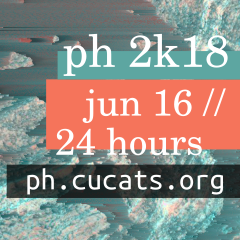
Get ready for a 24-hour puzzle hunt which will test you (and up to 2 team-mates) on a range of skills including logic, problem-solving and linguistics. Entry is free and we'll provide free pizza at midnight and free/subsidised dinner and drinks afterwards! So what are you waiting for? Sign up now at ph.cucats.org!
2018 Annual CUCaTS Puzzlehunt!Get ready for a 24-hour puzzle hunt which will test you (and up to 2 team-mates) on a range of skills including logic, problem-solving and linguistics. Entry is free and we'll provide free pizza at midnight and free/subsidised dinner and drinks afterwards! So what are you waiting for? Sign up now at ph.cucats.org!
|
| Thu 15 Feb 2018, 7:00pm | CUCaTS-TPP Pub Quiz/Challenge! (Problem Solving ; Free Dinner) | |
Thu 15 Feb 2018, 7:00pm | The Maypole (Top floor)

|
CUCaTS is very excited to announce, in partnership with TPP, a pub quiz on Thursday 15th! Unlike a typical pub quiz, the format of this one will me more akin to questions from Project Euler, and so you'll need to exercise your problem solving skills to tackle the range of challenges sets instead of applying your general knowledge (in fact, laptops are encouraged)!
There will be a free pizza dinner and plenty of drinks both on the tables and free at the bar (get a stamp from TPP to get on the tab!). There will also be prizes for the winning team (Raspberry Pi 3's each) as well as spot-prizes.
We recommend teams of about 5-6 people, but smaller groups are welcome too, and if you're unsure who to come with then we'll be happy to match you up with other keen problem solvers :) It's a good ... (more)
CUCaTS-TPP Pub Quiz/Challenge! (Problem Solving ; Free Dinner)CUCaTS is very excited to announce, in partnership with TPP, a pub quiz on Thursday 15th! Unlike a typical pub quiz, the format of this one will me more akin to questions from Project Euler, and so you'll need to exercise your problem solving skills to tackle the range of challenges sets instead of applying your general knowledge (in fact, laptops are encouraged)!
There will be a free pizza dinner and plenty of drinks both on the tables and free at the bar (get a stamp from TPP to get on the tab!). There will also be prizes for the winning team (Raspberry Pi 3's each) as well as spot-prizes.
We recommend teams of about 5-6 people, but smaller groups are welcome too, and if you're unsure who to come with then we'll be happy to match you up with other keen problem solvers :) It's a good idea to bring at least one programmer, but don't be put off if you don't have much experience!
To register your interest, sign up here! https://goo.gl/ydy4FU
Facebook: https://www.facebook.com/events/241635039711236/
Date/time: Thursday 15th Feb / 7pm-9pm
Location: The Maypole (Top Floor), 20A Portugal Pl, Cambridge CB5 8AF
This should be a lot of fun and there's plenty of free food and drink so don't miss out!
|
| Tue 07 Nov 2017, 7:45pm | Newton's Finger | Dr Conor McBride (University of Strathclyde) |
Tue 07 Nov 2017, 7:45pm | MR3, Centre for Mathematical Sciences, Wilberforce Road, Cambridge
Dr Conor McBride (University of Strathclyde) speaks on
|
This is our first talk of the year, presented by Dr Conor McBride! The talk title is ‘Newton’s Finger’ and will explore the relationship between Newton and Leibniz derivatives and computer data types, it should be a very interesting talk regardless of background knowledge! As always, we will be heading to the pub after for free drinks, so don’t miss out :)
Newton's notion of "divided difference", D(F)(X,Y) = (F(Y) - F(X))/(Y-X) makes perfect sense for container-like data structures, F(-), even in the absence of "subtraction" or "division". We may rather consider solutions to the equation (or type isomorphism)
F(Y) + D(F)(X,Y)*X = Y*D(F)(X,Y) + F(X)
which witnesses how to travel "left-to-right" through an F(-)-structure, gradually turning Ys into Xs. D(F)(X,Y) represents a snapshot in the process, where there is a finger over a place where a Y has been removed but an X has yet to be inserted, but there are Xs "left of the finger", and Ys "right of the finger". Just as various limits of the divided differnce play a useful role in mathematics, so the same limits have computational meaning. Leibniz's derivative F'(X) = D(F)(X,X) gives the type of "one-hole contexts" for an X in an F(X). Meanwhile, D(F)(0,Y) (i.e., nothing left of the finger) gives a formal notion of "division by Y with remainder F(0)", but also plays a vital role in Brzozowski's differential analysis of regular expressions. Lastly, D(F)(X,1), also known as "Fox's free deriviative", captures F(-) structures under construction, with stubs right of the finger, in place of values not yet computed.
In any functional programming language that treats datatype descriptions as first-class notions, we can just do the mathematics and extract the functionality in general, once for all.
Newton's FingerThis is our first talk of the year, presented by Dr Conor McBride! The talk title is ‘Newton’s Finger’ and will explore the relationship between Newton and Leibniz derivatives and computer data types, it should be a very interesting talk regardless of background knowledge! As always, we will be heading to the pub after for free drinks, so don’t miss out :)
Newton's notion of "divided difference", D(F)(X,Y) = (F(Y) - F(X))/(Y-X) makes perfect sense for container-like data structures, F(-), even in the absence of "subtraction" or "division". We may rather consider solutions to the equation (or type isomorphism)
F(Y) + D(F)(X,Y)*X = Y*D(F)(X,Y) + F(X)
which witnesses how to travel "left-to-right" through an F(-)-structure, gradually turning Ys into Xs. D(F)(X,Y) represents a snapshot in the process, where there is a finger over a place where a Y has been removed but an X has yet to be inserted, but there are Xs "left of the finger", and Ys "right of the finger". Just as various limits of the divided differnce play a useful role in mathematics, so the same limits have computational meaning. Leibniz's derivative F'(X) = D(F)(X,X) gives the type of "one-hole contexts" for an X in an F(X). Meanwhile, D(F)(0,Y) (i.e., nothing left of the finger) gives a formal notion of "division by Y with remainder F(0)", but also plays a vital role in Brzozowski's differential analysis of regular expressions. Lastly, D(F)(X,1), also known as "Fox's free deriviative", captures F(-) structures under construction, with stubs right of the finger, in place of values not yet computed.
In any functional programming language that treats datatype descriptions as first-class notions, we can just do the mathematics and extract the functionality in general, once for all.
Conor McBrideUniversity of Strathclyde Conor is a previous alumnus of Cambridge who went on to complete a PhD in dependent type theory at Edinburgh University. He now works at the University of Strathclyde where he continues to work on functional programming and type theory. Some examples of the work he has done include finding links between calculus and types, and the development of the dependently typed language Epigram. His well known papers include ‘Clowns to the left of me, jokers to the right’ and ‘Do Be Do Be Do’.
|
| Sat 21 Oct 2017, 10:00am | Jane Street: Programming Contest | |
Sat 21 Oct 2017, 10:00am | TBC

|
Jane Street will be visiting Cambridge this October for our Electronic Trading Challenge and we invite you and your classmates and friends!
We'll be hosting an Electronic Trading Challenge (ETC), a day-long programming contest where participants compete against each other in a simulated market. We'll begin at 10:00am BST on Saturday 21st October and continue into the night. Breakfast, lunch, and dinner will be provided and there's a cash prize for the winning team.
You can sign up either as a single participant or as a team. If you sign up alone we'll randomly assign you to a team.
This event is intended only for students currently enrolled at the University of Cambridge.
Register here!
Sign-ups will close on Sunday 15th October at 11:59pm ... (more)
Jane Street: Programming ContestJane Street will be visiting Cambridge this October for our Electronic Trading Challenge and we invite you and your classmates and friends!
We'll be hosting an Electronic Trading Challenge (ETC), a day-long programming contest where participants compete against each other in a simulated market. We'll begin at 10:00am BST on Saturday 21st October and continue into the night. Breakfast, lunch, and dinner will be provided and there's a cash prize for the winning team.
You can sign up either as a single participant or as a team. If you sign up alone we'll randomly assign you to a team.
This event is intended only for students currently enrolled at the University of Cambridge.
Register here!
Sign-ups will close on Sunday 15th October at 11:59pm BST, and we'll notify all interested students of their attendance by Tuesday 17th October. Due to potential space constraints we are only going to provide the location and other details to those who are confirmed for a spot.
[Jane Street asserts no ownership over any content created in the competition. Jane Street's use of the content created is limited to reviewing participants' work to ensure fairness of the competition.]
|
| Mon 16 Oct 2017, 6:00pm | MIT: Data Science and Analytics Program | Michelle Li (MIT) |
Mon 16 Oct 2017, 6:00pm | TBC
Michelle Li (MIT) speaks on

|
We're excited to be hosting a presentation from Michelle Li, director of the Masters in Business Analytics degree at MIT.
The newly created Masters in Business Analytics degree is a one-year program from the MIT Sloan Management School and is designed to prepare students for careers in data science and business analytics.
All are welcome, especially those who may be interested in attending MIT for postgraduate studies in the future. The event will consist of a 30 minute presentation, followed by time for Q+A.
MIT: Data Science and Analytics ProgramWe're excited to be hosting a presentation from Michelle Li, director of the Masters in Business Analytics degree at MIT.
The newly created Masters in Business Analytics degree is a one-year program from the MIT Sloan Management School and is designed to prepare students for careers in data science and business analytics.
All are welcome, especially those who may be interested in attending MIT for postgraduate studies in the future. The event will consist of a 30 minute presentation, followed by time for Q+A.
|
| Tue 08 Nov 2016, 7:30pm | An Overview of Blockchain Security | Dr Nicolas Courtois (University College London) |
Tue 08 Nov 2016, 7:30pm | pin Meeting Room 3, CMS (Centre for Mathematical Sciences, Wilberforce Road)
Dr Nicolas Courtois (University College London) speaks on

|
In this presentation we will overview a number of important questions which underpin the security of blockchains.
We study Chaumian and Nakamoto e-cash, see why bitcoin is quite slow, explain the role of digital signatures and mining in building so called "trustless systems", study the bitcoin network and 51% attacks, explain some issues with ECC cryptography. Then we study some techniques which allow to make bitcoin payments more secure (e.g. hardware wallets) and more private (stealth address, ring signatures).
An Overview of Blockchain SecurityIn this presentation we will overview a number of important questions which underpin the security of blockchains.
We study Chaumian and Nakamoto e-cash, see why bitcoin is quite slow, explain the role of digital signatures and mining in building so called "trustless systems", study the bitcoin network and 51% attacks, explain some issues with ECC cryptography. Then we study some techniques which allow to make bitcoin payments more secure (e.g. hardware wallets) and more private (stealth address, ring signatures).
Nicolas Courtois University College London Nicolas Courtois is a cryptographer and senior lecturer in computer science at University College London.
He was one of the co-authors of both the XSL attack against block ciphers such as the Advanced Encryption Standard and the XL system for solving systems of algebraic equations that was used in the attack. Other cryptographic results of Courtois include algebraic attacks on stream ciphers, attacks on the KeeLoq and Hitag 2 systems used for remote keyless automobile entry systems, and an analysis of cryptographic weaknesses in public transit smart cards including the London Underground Oyster card and the Dutch national analogue (OV-chipkaart). He holds more than a dozen patents, has more than a hundred publications and his blog is often cited in the press.
More recently, he has been working on (and blogging about) cryptocurrencies and he’ll talk to us about security aspects of the innovative technology underlying them, blockchains!
|
| Tue 01 Nov 2016, 7:30pm | On the road to traction - lessons learned in the startup world | Dan Greenfield (PetaGene) |
Tue 01 Nov 2016, 7:30pm | Harrods Room, Queens Building, Emmanuel College
Dan Greenfield (PetaGene) speaks on

|
This is a talk about a startup journey leading to PetaGene. Genomic data is rapidly growing – in 2018 alone, there will be more data generated from next generation sequencers (NGS) than all the videos on YouTube put together. PetaGene addresses these challenges by making genomics data smaller, faster and better.
On the road to traction - lessons learned in the startup worldThis is a talk about a startup journey leading to PetaGene. Genomic data is rapidly growing – in 2018 alone, there will be more data generated from next generation sequencers (NGS) than all the videos on YouTube put together. PetaGene addresses these challenges by making genomics data smaller, faster and better.
Dan GreenfieldPetaGene Speaker bio: Dr Dan Greenfield is the CEO of PetaGene Ltd. He has spent many years working on ground breaking products in Silicon Valley in parallel computing and advanced networking. He has a Masters in Bioinformatics and his PhD in Computer Science from the University of Cambridge was awarded the 2011 CHPC /BCS Prize for the top Computer Science PhD dissertation in the UK. Working in collaboration Dr Stegle’s group at EMBL -EBI, Dr Greenfield guided the development of PetaGene’s technology.
|
| Mon 10 Oct 2016, 8:30pm | Securing computers from highly skilled attackers | Matthew Garrett (CoreOS) |
Mon 10 Oct 2016, 8:30pm | Queen's Building Lecture Theatre, Emmanuel College
Matthew Garrett (CoreOS) speaks on

|
The modern world keeps giving us demonstrations of governments finding new and exciting ways to spy on computers. It’s unlikely that you’ll be the target of any of this surveillance, but where governments start, criminals probably won’t be too far behind. We’ll talk about some of the more unsettling attacks seen in the past few years, but also discuss some of the things normal users can do to protect against them.
Securing computers from highly skilled attackersThe modern world keeps giving us demonstrations of governments finding new and exciting ways to spy on computers. It’s unlikely that you’ll be the target of any of this surveillance, but where governments start, criminals probably won’t be too far behind. We’ll talk about some of the more unsettling attacks seen in the past few years, but also discuss some of the things normal users can do to protect against them.
Matthew GarrettCoreOS Matthew Garrett (screenname: mjg59) is a kernel developer who is a major contributor to CoreOS, Debian, Red Hat, Ubuntu, and many other projects. He did his PhD in genetics here in Cambridge (which explains the screenname!), where he worked with fruitflies. When not watching "Hackers" or replying to tons to emails, Matthew likes to exploit security systems of hotels with Android-enabled light switches and blog about it (http://mjg59.dreamwidth.org/40505.html). He was awarded the Free Software Award from the Free Software Foundation for his work on Secure Boot, UEFI, and the Linux kernel.
|
| Tue 01 Mar 2016, 7:45pm | Inside the beast: GHC’s intermediate lambda language | Professor Simon Peyton Jones (Microsoft Research) |
Tue 01 Mar 2016, 7:45pm | Centre for Mathematical Sciences, MR3
Professor Simon Peyton Jones (Microsoft Research) speaks on

|
This talk is by Prof. Simon Peyton Jones (Microsoft Research) who will be talking about The Glasgow Haskell Compiler (GHC). Entry is FREE to everyone and attendees are welcome to join us at the pub afterwards where CUCaTS will buy your first pint/drink. FREE BEER!
Abstract: GHC translates all of Haskell into a tiny intermediate language called Core, does a lot of optimisations on Core, and then generates executable code. In this talk I’ll take you on a journey into Core, with several goals. First, if you ever do performance-debugging of a Haskell program you may well find yourself staring at Core dumps to understand the program that the computer is executing (it may look nothing like the one you wrote!). Second, one way to extend GHC is to write a Core-to-Core plugin to do some cool optimisation or transformation that you want; and you can only do that if you understand Core. Lastly, even if you want to do none of these things, I think you may enjoy the adventure. Core is a tiny but super-expressive language that can express all of Haskell, including all the types, and more beside. It pulls off this trick by drawing directly on System F, a mathematical calculus from type theory. Functional programming is amazing: serious theory leads directly to beautiful implementations.
Come along to the talk to find out about GHC from the lead designer himself!
Inside the beast: GHC’s intermediate lambda languageThis talk is by Prof. Simon Peyton Jones (Microsoft Research) who will be talking about The Glasgow Haskell Compiler (GHC). Entry is FREE to everyone and attendees are welcome to join us at the pub afterwards where CUCaTS will buy your first pint/drink. FREE BEER!
Abstract: GHC translates all of Haskell into a tiny intermediate language called Core, does a lot of optimisations on Core, and then generates executable code. In this talk I’ll take you on a journey into Core, with several goals. First, if you ever do performance-debugging of a Haskell program you may well find yourself staring at Core dumps to understand the program that the computer is executing (it may look nothing like the one you wrote!). Second, one way to extend GHC is to write a Core-to-Core plugin to do some cool optimisation or transformation that you want; and you can only do that if you understand Core. Lastly, even if you want to do none of these things, I think you may enjoy the adventure. Core is a tiny but super-expressive language that can express all of Haskell, including all the types, and more beside. It pulls off this trick by drawing directly on System F, a mathematical calculus from type theory. Functional programming is amazing: serious theory leads directly to beautiful implementations.
Come along to the talk to find out about GHC from the lead designer himself!
Simon Peyton JonesMicrosoft Research Simon Peyton Jones, MA, MBCS, CEng, graduated from Trinity College Cambridge in 1980. After two years in industry, he spent seven years as a lecturer at University College London, and nine years as a professor at Glasgow University, before moving to Microsoft Research (Cambridge) in 1998. His main research interest is in functional programming languages, their implementation, and their application. He was a key contributor to the design of the now-standard functional language Haskell, and is the lead designer of the widely-used Glasgow Haskell Compiler (GHC). He has written two textbooks about the implementation of functional languages.
|
| Tue 01 Dec 2015, 8:00pm | Computing and Technology Pub Social | |
Tue 01 Dec 2015, 8:00pm | The Mill

|
First drink is free! Join the Computing and Technology Society at The Mill for thinking and drinking, beer and cheer.
Everyone welcome!
Computing and Technology Pub SocialFirst drink is free! Join the Computing and Technology Society at The Mill for thinking and drinking, beer and cheer.
Everyone welcome!
|
| Tue 13 Oct 2015, 7:30pm | Quantum Contextuality: from paradox to computational resource | Professor Samson Abramsky (University of Oxford) |
Tue 13 Oct 2015, 7:30pm | Lecture Theatre, Trinity Hall
Professor Samson Abramsky (University of Oxford) speaks on
|
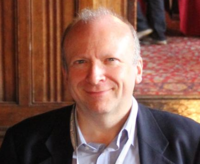
Our first talk this year is by Prof. Samson Abramsky from the University of Oxford, who will be talking about quantum computing. Read more about his work here on his webpage.
A little about Samson Abramsky: He has played a leading role in the development of game semantics, and its applications to the semantics of programming languages. Other notable contributions include his work on domain theory in logical form, the lazy lambda calculus, strictness analysis, concurrency theory, interaction categories, and geometry of interaction. He has recently been working on high-level methods for quantum computation and information.
Come along to find out more about quantum computation from the pioneer himself! Let us know you're coming on the Facebook event.
Quantum Contextuality: from paradox to computational resourceOur first talk this year is by Prof. Samson Abramsky from the University of Oxford, who will be talking about quantum computing. Read more about his work here on his webpage.
A little about Samson Abramsky: He has played a leading role in the development of game semantics, and its applications to the semantics of programming languages. Other notable contributions include his work on domain theory in logical form, the lazy lambda calculus, strictness analysis, concurrency theory, interaction categories, and geometry of interaction. He has recently been working on high-level methods for quantum computation and information.
Come along to find out more about quantum computation from the pioneer himself! Let us know you're coming on the Facebook event.
|
| Tue 10 Mar 2015, 6:15pm | Programming Biology | Dr Andrew Phillips (Microsoft Research) |
Tue 10 Mar 2015, 6:15pm | Bateman Auditorium, Caius College
Dr Andrew Phillips (Microsoft Research) speaks on

|
The ability to program biological systems as effectively as we currently program digital computers could enable fundamental
breakthroughs in biotechnology. Applications include the detection and treatment of disease to a level of precision that has not been possible so far, the production of clean energy in a sustainable way, and the biofabrication of new medicines, fuels and materials. In spite of this potential there are still many challenges to overcome. First and foremost, programming biological systems is complex and error-prone, and we are at a point where powerful computer software could significantly accelerate further progress. This talk presents ongoing work to develop computer software for programming biological systems. We present software for programming molecular circuits made of DNA and for characterising genetic parts that can be combined into devices for programming cell function. Just as software for programming digital computers transformed the technology landscape, software for programming biological systems could enable entirely new industries in biotechnology.
Programming BiologyThe ability to program biological systems as effectively as we currently program digital computers could enable fundamental
breakthroughs in biotechnology. Applications include the detection and treatment of disease to a level of precision that has not been possible so far, the production of clean energy in a sustainable way, and the biofabrication of new medicines, fuels and materials. In spite of this potential there are still many challenges to overcome. First and foremost, programming biological systems is complex and error-prone, and we are at a point where powerful computer software could significantly accelerate further progress. This talk presents ongoing work to develop computer software for programming biological systems. We present software for programming molecular circuits made of DNA and for characterising genetic parts that can be combined into devices for programming cell function. Just as software for programming digital computers transformed the technology landscape, software for programming biological systems could enable entirely new industries in biotechnology.
|
| Tue 18 Nov 2014, 8:00pm | EF Tech Talk: Cambridge students starting startups | Amar Sood and Diggory Blake (Entrepreneur First) |
Tue 18 Nov 2014, 8:00pm | Plant Sciences Lecture Theatre, Downing Site
Amar Sood and Diggory Blake (Entrepreneur First) speaks on

|
We are joined by two ex-Cambridge CompScis who are now on the 2014-15 Entrepreneur First cohort. EF is a startup accelerator based in London.
Amar Sood and Diggory Blake will be talking about their startup. They'll also speak about how they made the transition from university to working on the cool tech that they're interested in.
Amar and Diggory will be joined by representatives from EF, who are looking for the very best technical students to join their 2015-16 cohorts. If you're interested in entrepreneurship and the startup scene, this is a must-attend event!
Let us know you're coming on the Facebook event.
EF Tech Talk: Cambridge students starting startupsWe are joined by two ex-Cambridge CompScis who are now on the 2014-15 Entrepreneur First cohort. EF is a startup accelerator based in London.
Amar Sood and Diggory Blake will be talking about their startup. They'll also speak about how they made the transition from university to working on the cool tech that they're interested in.
Amar and Diggory will be joined by representatives from EF, who are looking for the very best technical students to join their 2015-16 cohorts. If you're interested in entrepreneurship and the startup scene, this is a must-attend event!
Let us know you're coming on the Facebook event.
|
| Tue 28 Oct 2014, 8:00pm | #include <Computer Science and Social Mobility> | Pete Kemp (TeachFirst) |
Tue 28 Oct 2014, 8:00pm | Plant Sciences Lecture Theatre, Downing Site
Pete Kemp (TeachFirst) speaks on

|
Our second talk of the term comes from Pete Kemp, a CS educator who, among many other projects, was on the drafting panel of the new ICT curriculum. He's now Senior Lecturer in Computing Education at the University of Roehampton and a TeachFirst ambassador. Previously he taught ICT at sixth form level and founded AMBICT, a self-help and innovation group for ICT teachers at schools in challenging circumstances.
During his talk he'll be discussing his experiences teaching ICT in challenging schools, and how computer scientists can contribute to social mobility. He'll also discuss his role in drafting the new ICT curriculum, and how computers will influence the future of learning.
#include <Computer Science and Social Mobility>Our second talk of the term comes from Pete Kemp, a CS educator who, among many other projects, was on the drafting panel of the new ICT curriculum. He's now Senior Lecturer in Computing Education at the University of Roehampton and a TeachFirst ambassador. Previously he taught ICT at sixth form level and founded AMBICT, a self-help and innovation group for ICT teachers at schools in challenging circumstances.
During his talk he'll be discussing his experiences teaching ICT in challenging schools, and how computer scientists can contribute to social mobility. He'll also discuss his role in drafting the new ICT curriculum, and how computers will influence the future of learning.
|
| Tue 14 Oct 2014, 8:00pm | Long-Term Autonomy in Everyday Environments: A New Challenge for AI and Robotics | Dr Nick Hawes (University of Birmingham) |
Tue 14 Oct 2014, 8:00pm | Plant Sciences Lecture Theatre, Downing Site
Dr Nick Hawes (University of Birmingham) speaks on
|
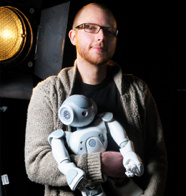
The performance of autonomous robots, i.e. robots that can make their own decisions and choose their own actions, is becoming increasingly impressive, but most of them are still constrained to labs, or controlled environments. In addition to this, these robots are typically only able to do intelligent things for a short period of time, before either crashing (physically or digitally) or running out of things to do. In order to go beyond these limitations, and to deliver the kind of autonomous service robots required by society, we must conquer the challenge of combining artificial intelligence and robotics to develop systems capable of long-term autonomy in everyday environments. This talk will present an overview of research in this direction, focussing on the mobile robots for security and care domains developed by the EU-funded STRANDS project.
Read more about Nick on his webpage.
Let us know you're coming on the Facebook event.
Long-Term Autonomy in Everyday Environments: A New Challenge for AI and RoboticsThe performance of autonomous robots, i.e. robots that can make their own decisions and choose their own actions, is becoming increasingly impressive, but most of them are still constrained to labs, or controlled environments. In addition to this, these robots are typically only able to do intelligent things for a short period of time, before either crashing (physically or digitally) or running out of things to do. In order to go beyond these limitations, and to deliver the kind of autonomous service robots required by society, we must conquer the challenge of combining artificial intelligence and robotics to develop systems capable of long-term autonomy in everyday environments. This talk will present an overview of research in this direction, focussing on the mobile robots for security and care domains developed by the EU-funded STRANDS project.
Read more about Nick on his webpage.
Let us know you're coming on the Facebook event.
|
| Mon 16 Jun 2014, 1:00pm | Science Societies' Garden Party 2014 | |
Mon 16 Jun 2014, 1:00pm | Library Lawn, Pembroke College

|
We are delighted to invite you for the long-awaited, eagerly-anticipated, highly-contemplated 2014 Science Societies' Garden Party!
It promises to be a fantastic afternoon, with plenty of food, drink and, who knows, perhaps even a few surprises...
Buy a ticket / "attend" the Facebook event.
The participating societies are:
- Cambridge University Scientific Society (SciSoc)
- Cambridge University Physics Society (CUPS)
- Cambridge University Mathematical Society (Archimedeans)
- Cambridge University Astronomical Society (CUAS)
- Cambridge University Computing and Technology ... (more)
Science Societies' Garden Party 2014We are delighted to invite you for the long-awaited, eagerly-anticipated, highly-contemplated 2014 Science Societies' Garden Party!
It promises to be a fantastic afternoon, with plenty of food, drink and, who knows, perhaps even a few surprises...
Buy a ticket / "attend" the Facebook event.
The participating societies are:
- Cambridge University Scientific Society (SciSoc)
- Cambridge University Physics Society (CUPS)
- Cambridge University Mathematical Society (Archimedeans)
- Cambridge University Astronomical Society (CUAS)
- Cambridge University Computing and Technology Society (CUCaTS)
- Cambridge University Biological Society (BioSoc)
|
| Sat 14 Jun 2014, 6:00am | Third Annual CUCaTS Puzzlehunt | |
Sat 14 Jun 2014, 6:00am | Great St Mary's

|
The Puzzlehunt is a team puzzle-solving and treasure-hunting competition. Your team will navigate its way through a mental and sometimes physical obstacle course of challenging and fun computational, mathematical and linguistic puzzles, seeking to cut its way through to the goal before everyone else. Like last year, it will be held in Cambridge - all of it! - over the course of 24 hours. The puzzlehunt will begin with a kick-off briefing after we meet-up at 4pm on Saturday in front of Great St Mary's.
Things you need to know:
* No preparation is necessary - just come along on the day!
* It's a 24 hour event, though much more fun than any hackathon - be prepared to spend the day running about Cambridge and hacking away on a variety of mind-bending puzzles!
* You can bring your own team ... (more)
Third Annual CUCaTS PuzzlehuntThe Puzzlehunt is a team puzzle-solving and treasure-hunting competition. Your team will navigate its way through a mental and sometimes physical obstacle course of challenging and fun computational, mathematical and linguistic puzzles, seeking to cut its way through to the goal before everyone else. Like last year, it will be held in Cambridge - all of it! - over the course of 24 hours. The puzzlehunt will begin with a kick-off briefing after we meet-up at 4pm on Saturday in front of Great St Mary's.
Things you need to know:
* No preparation is necessary - just come along on the day!
* It's a 24 hour event, though much more fun than any hackathon - be prepared to spend the day running about Cambridge and hacking away on a variety of mind-bending puzzles!
* You can bring your own team (of size 3) or come along and be matched up.
* We'll feed you twice - midnight pizza is a classic and then a post-puzzlehunt dinner subsidised by CUCaTS.
* There are a bunch of prizes - for coming in the first few places and for special achievements, too!
* While you're free to just turn up on the day, it will help us get an idea for numbers if you sign up using our form: http://cucats.soc.srcf.net/puzzlehunt-signup
See our Facebook event for up-to-date information: https://www.facebook.com/events/793003394051201/
We look forward to seeing you there!
|
| Sat 01 Mar 2014, 8:00am | Paintballing with Oxford CompSoc | |
Sat 01 Mar 2014, 8:00am | Delta Force Luton

|
Paintballing with CUCaTS and Oxford University Computer Society! After a successful event last year, we've teamed up again for even more fun. A great way to get out of the bubble and let loose all that pent-up frustration on some people from The Other Place!
Palantir are very generously supporting the event so it will be FREE OF CHARGE, including transport to and from the venue.
NOTE however that, due to our arrangement with Palantir, we can only invite current Computer Scientists.
Places are limited, so please RSVP using the signup form.
Paintballing with Oxford CompSocPaintballing with CUCaTS and Oxford University Computer Society! After a successful event last year, we've teamed up again for even more fun. A great way to get out of the bubble and let loose all that pent-up frustration on some people from The Other Place!
Palantir are very generously supporting the event so it will be FREE OF CHARGE, including transport to and from the venue.
NOTE however that, due to our arrangement with Palantir, we can only invite current Computer Scientists.
Places are limited, so please RSVP using the signup form.
|
| Thu 27 Feb 2014, 7:00pm | WikiData: a free knowledge base that can be read and edited by humans and machines alike | Dr Magnus Manske () |
Thu 27 Feb 2014, 7:00pm | Plant Sciences Lecture Theatre, Downing Site
Dr Magnus Manske () speaks on

|
In a joint talk with the Wikipedia Society, Dr Magnus Manske will speak on Wikidata: the free knowledge base that can be read and edited by humans and machines alike. It is for data what Wikimedia Commons is for media files: it centralizes access to and management of structured data, such as interwiki references and statistical information. It has been described as one of the most exciting innovations in encyclopedic history, since it enables us to structure data on Wikipedia and interlink concepts from different languages. Come along to learn more about all its functionality, how it works, and how it will change the future!
WikiData: a free knowledge base that can be read and edited by humans and machines alikeIn a joint talk with the Wikipedia Society, Dr Magnus Manske will speak on Wikidata: the free knowledge base that can be read and edited by humans and machines alike. It is for data what Wikimedia Commons is for media files: it centralizes access to and management of structured data, such as interwiki references and statistical information. It has been described as one of the most exciting innovations in encyclopedic history, since it enables us to structure data on Wikipedia and interlink concepts from different languages. Come along to learn more about all its functionality, how it works, and how it will change the future!
Magnus ManskeMagnus Manske, a biochemist by day, was the developer of one of the first versions of the MediaWiki software. Manske studied biochemistry at the University of Cologne and graduated in 2006 with a PhD; his dissertation was an open source tool for molecular biology called GENtle. As a student he was one of the first contributors to the Internet encyclopedia NuPedia, the precursor to Wikipedia, and later wrote one of the first versions of the MediaWiki software that Wikipedia runs on. Manske has worked in Cambridge with the Wellcome Trust Sanger Institute since April 2007, but remains active in the development of tools for Wikipedia.
|
| Wed 29 Jan 2014, 7:00pm | Domain-specific languages and Xtext | David North and Peter Cowan (CoreFiling) |
Wed 29 Jan 2014, 7:00pm | The Lightfoot Room, Divinity School, St Johns
David North and Peter Cowan (CoreFiling) speaks on

|
Computer scientists and mathematicians will both be familiar with the idea of a "language" to describe specific problems concisely. But how are such things built and used in the commercial world? David North and Peter Cowan from CoreFiling, a specialist software company based in Oxford, will talk about the technical and human challenges in building a computer language for writing rules about financial data.
Domain-specific languages and XtextComputer scientists and mathematicians will both be familiar with the idea of a "language" to describe specific problems concisely. But how are such things built and used in the commercial world? David North and Peter Cowan from CoreFiling, a specialist software company based in Oxford, will talk about the technical and human challenges in building a computer language for writing rules about financial data.
David North and Peter CowanCoreFiling David North is a software developer and team leader at CoreFiling. He's worked for CoreFiling for just over four years on a variety of projects involving machine learning, web development and desktop applications. Before that, he studied Computing at Oxford. You can visit his personal site at www.dnorth.net .
Peter Cowan is a software engineer at CoreFiling and the current
product development intern manager. He graduated in 2012 with a
Computer Science degree from Jesus College, Cambridge.
|
| Thu 23 Jan 2014, 5:45pm | Computer-Based Maths: Stop Teaching Calculating, Start Learning Maths | Conrad Wolfram (Wolfram & computerbasedmath.org) |
Thu 23 Jan 2014, 5:45pm | Center for Mathematical Sciences
Conrad Wolfram (Wolfram & computerbasedmath.org) speaks on
|
The importance of math to jobs, society, and thinking has exploded over the last few decades. Meanwhile, math education is in worldwide crisis—diverging more and more from what's required by countries, industry, further education... and students.
math ≠ calculating. Computers are key to bridging this chasm: only when they do the calculating is math applicable to hard questions across many contexts. Real-life math has been transformed by computer-based calculation; now mainstream math education needs this fundamental change too.
computerbasedmath.org is the project to perform this reset. We're building a completely new math curriculum with computer-based computation at its heart, while campaigning at all levels to redefine math education away from historical hand-calculating techniques and toward real-life problem-solving situations that drive high-concept math understanding and experience.
Computer-Based Maths: Stop Teaching Calculating, Start Learning MathsThe importance of math to jobs, society, and thinking has exploded over the last few decades. Meanwhile, math education is in worldwide crisis—diverging more and more from what's required by countries, industry, further education... and students.
math ≠ calculating. Computers are key to bridging this chasm: only when they do the calculating is math applicable to hard questions across many contexts. Real-life math has been transformed by computer-based calculation; now mainstream math education needs this fundamental change too.
computerbasedmath.org is the project to perform this reset. We're building a completely new math curriculum with computer-based computation at its heart, while campaigning at all levels to redefine math education away from historical hand-calculating techniques and toward real-life problem-solving situations that drive high-concept math understanding and experience.
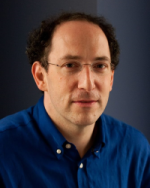
Conrad WolframWolfram & computerbasedmath.org Conrad Wolfram, physicist, mathematician and technologist, is European co-founder/CEO of the Wolfram group of companies and founder of computerbasedmath.org. Described as the place where "Computation meets Knowledge" and the "The Math Company", the Wolfram Group specializes in pushing boundaries at the intersection of computation, math, and knowledge, including making
Mathematica software, the Wolfram|Alpha knowledge engine (powering
knowledge answers for Apple's Siri), the new Computable Document Format (CDF) standard and the forthcoming Wolfram Language.
Conrad is also the world's leading advocate for a fundamental shift of maths education to be computer-based, arguing that this is the only way to solve the global maths education crisis. His widely acknowledged 2010 TED talk laid out the rationale and roadmap for this rethink and the same year he founded computerbasedmath.org (CBM) to drive implementation of the change. The movement is now a worldwide force in re-engineering the STEM curriculum, and in February 2013 it was announced that Estonia would be the first CBM country. Conrad regularly appears in the media and as a keynote speaker on subjects ranging from the future of the web to 21st
century education. He holds degrees in natural sciences and maths from University of Cambridge.
|
| Wed 04 Dec 2013, 8:00pm | Computing and Technology Pub Social | |
Wed 04 Dec 2013, 8:00pm | The Maypole

|
Head down to The Maypole at 20.00 this Wednesday (4/12) to celebrate the end of term and discuss computing, technology and lots more! Furthermore, the first round will be on us. Absolutely everybody is welcome to attend, including non-members. We hope to see lots of you there!
Computing and Technology Pub SocialHead down to The Maypole at 20.00 this Wednesday (4/12) to celebrate the end of term and discuss computing, technology and lots more! Furthermore, the first round will be on us. Absolutely everybody is welcome to attend, including non-members. We hope to see lots of you there!
|
| Wed 20 Nov 2013, 8:00pm | Computing and Technology Pub Social | |
Wed 20 Nov 2013, 8:00pm | The Maypole

|
The first pub social of term will be held this coming Wednesday at The Maypole from 8pm onwards. As always, anyone interested in discussing computers, computer science and technology should come along for a pint and a chat about those things (or anything else really).
Absolutely everyone is welcome to come, including non-members.
Computing and Technology Pub SocialThe first pub social of term will be held this coming Wednesday at The Maypole from 8pm onwards. As always, anyone interested in discussing computers, computer science and technology should come along for a pint and a chat about those things (or anything else really).
Absolutely everyone is welcome to come, including non-members.
|
| Thu 14 Nov 2013, 2:15pm | Personalised Recommendations in E-Commerce | Mr Wing Yung Chan (The Hut Group) |
Mr Wing Yung Chan (The Hut Group) speaks on

|
Personalisation is a typical Big Data problem. However, the ability to leverage data to produce suggestions that will be both relevant and interesting is a difficult task. This presentation looks at some of the algorithms we use for making good product recommendations in the e-commerce industry.
The Hut Group aims to be the World 's leading Online Health & Beauty Destination. We are currently the UK 's leading multi-website online retailer with rapidly growing international operations and a unique proprietary technology platform supporting our websites including market leaders www.myprotein.com, www.coggles.com and www.iwoot.com
Finally, the presentation will end with an announcement of The Hut Group Recommendation Challenge, a machine learning challenge with a £5000 prize up for grabs.
Personalised Recommendations in E-CommercePersonalisation is a typical Big Data problem. However, the ability to leverage data to produce suggestions that will be both relevant and interesting is a difficult task. This presentation looks at some of the algorithms we use for making good product recommendations in the e-commerce industry.
The Hut Group aims to be the World 's leading Online Health & Beauty Destination. We are currently the UK 's leading multi-website online retailer with rapidly growing international operations and a unique proprietary technology platform supporting our websites including market leaders www.myprotein.com, www.coggles.com and www.iwoot.com
Finally, the presentation will end with an announcement of The Hut Group Recommendation Challenge, a machine learning challenge with a £5000 prize up for grabs.
Wing Yung ChanThe Hut Group Wing Yung Chan is a Software Engineer and Researcher within the Technology & Innovation Team at The Hut Group. He was the first at the company to write an in-house recommendation system, which he developed as part of his final year dissertation. He graduated first in his class (Computer Science) from the University of Cambridge in July, 2013.
Ashley Ramrachia is Group Talent Director at The Hut Group with responsibility for hiring, developing and promoting the World's leading talent. He recently established the Group's industry pioneering Technology & Innovation team staffed by the brightest technical minds from Imperial and Cambridge. The group has a unique talent model offering significantly early responsibility to graduates, and has an average employee age of 25.
|
| Fri 14 Jun 2013, 4:00pm | Second CUCaTS Puzzlehunt | |
Fri 14 Jun 2013, 4:00pm | Meet Outside Great St. Mary's
|
Facebook event: https://www.facebook.com/events/486753391383604/
Signup: http://cucats.soc.srcf.net/puzzlehunt-signup
The Puzzlehunt is a team puzzle-solving and treasure-hunting competition. Your team will navigate its way through a mental and sometimes physical obstacle course of challenging and fun computational, mathematical and linguistic puzzles, seeking to cut its way through to the goal before everyone else. Like last year, it will be held in Cambridge - all of it! - over the course of 24 hours. The puzzlehunt will begin with a kickoff briefing at 4pm on Friday 14th June, meeting outside Great St. Mary's.
To give you a better idea ... (more)
Second CUCaTS PuzzlehuntFacebook event: https://www.facebook.com/events/486753391383604/
Signup: http://cucats.soc.srcf.net/puzzlehunt-signup
The Puzzlehunt is a team puzzle-solving and treasure-hunting competition. Your team will navigate its way through a mental and sometimes physical obstacle course of challenging and fun computational, mathematical and linguistic puzzles, seeking to cut its way through to the goal before everyone else. Like last year, it will be held in Cambridge - all of it! - over the course of 24 hours. The puzzlehunt will begin with a kickoff briefing at 4pm on Friday 14th June, meeting outside Great St. Mary's.
To give you a better idea of what to expect, the puzzles and solutions, including detailed explanations, of last year's puzzlehunt can be looked up in the dark recesses of our website here.
Teams may consist of up to 3 people. Regardless of whether you already have a complete team, do sign up at http://cucats.soc.srcf.net/puzzlehunt-signup - this also makes it possible for us to match you up with other people who are looking for teammates. If you want to update your registration at a later point, email Ben (bjw45@cam.ac.uk) with the details!
|
| Wed 01 May 2013, 8:00pm | Computing and Technology Pub Social | |
Wed 01 May 2013, 8:00pm | The Mitre, Bridge Street

|
The first pub social of term will be held this coming Wednesday and promises to provide an excellent break from exam revision. Members will be at The Mitre, on Bridge Street, from 8pm onwards. As always, anyone interested in discussing computers, computer science and technology should come along for a pint and a chat about those things (or anything else really).
Absolutely everyone is welcome to come, including non-members.
Computing and Technology Pub SocialThe first pub social of term will be held this coming Wednesday and promises to provide an excellent break from exam revision. Members will be at The Mitre, on Bridge Street, from 8pm onwards. As always, anyone interested in discussing computers, computer science and technology should come along for a pint and a chat about those things (or anything else really).
Absolutely everyone is welcome to come, including non-members.
|
| Wed 13 Mar 2013, 1:30pm | 4th Annual General Meeting | |
|
This year's Annual General Meeting is set to take place on Wednesday 13th March at 1:30pm. Most of the current committee are (reluctantly!) graduating out this year, so we are looking to fill most of the positions! If you think inviting famous speakers, going to free formals, commandeering a horde of minions and hoarding mugs with cat pictures on them is the right thing for you, there is only a handful of votes standing between you and fulfilment :)
We will conduct a review of the last year, followed by the much-anticipated elections for the next committee. For the purpose of nutrition, copious amounts of pizza shall be ordered.
Join us if you are thinking of running for the next committee, would like to make your vote heard, or just want to see what the fuss is all about and ... (more)
4th Annual General MeetingThis year's Annual General Meeting is set to take place on Wednesday 13th March at 1:30pm. Most of the current committee are (reluctantly!) graduating out this year, so we are looking to fill most of the positions! If you think inviting famous speakers, going to free formals, commandeering a horde of minions and hoarding mugs with cat pictures on them is the right thing for you, there is only a handful of votes standing between you and fulfilment :)
We will conduct a review of the last year, followed by the much-anticipated elections for the next committee. For the purpose of nutrition, copious amounts of pizza shall be ordered.
Join us if you are thinking of running for the next committee, would like to make your vote heard, or just want to see what the fuss is all about and get a free lunch out of it!
|
| Tue 12 Mar 2013, 6:00pm | Computer Science and Statistics in Algorithmic Trading: A Sampler | Dr Hasan Amjad (Cantab Capital Partners) |
Dr Hasan Amjad (Cantab Capital Partners) speaks on

|
Algorithmic trading is the computerised buying and selling of assets on electronic markets, often at timescales of milliseconds or less. We take a whistle-stop tour through one day in the life of a trading algorithm, encountering NP-complete problems, temporal logic, machine learning and stochastic optimisation.
Computer Science and Statistics in Algorithmic Trading: A SamplerAlgorithmic trading is the computerised buying and selling of assets on electronic markets, often at timescales of milliseconds or less. We take a whistle-stop tour through one day in the life of a trading algorithm, encountering NP-complete problems, temporal logic, machine learning and stochastic optimisation.
Hasan AmjadCantab Capital Partners Hasan got his PhD at the Automated Reasoning Group at the Cambridge University Computer Laboratory in 2004, where he is currently a Visiting Fellow. In 2008, he joined Cantab Capital Partners, a systematic hedge fund based in Cambridge, where he leads research and development on the firm’s algorithmic trading infrastructure.
|
| Wed 06 Mar 2013, 8:00pm | Pub Social VI | |

|
The final pub social of this term, and the last one that can be compared to a Star Wars episode (for now at least). As before, anyone interested in discussing computers, computer science and technology should come along for a pint and a chat about those things (or anything else,really). Absolutely everyone is welcome to come, including non-members.
Pub Social VIThe final pub social of this term, and the last one that can be compared to a Star Wars episode (for now at least). As before, anyone interested in discussing computers, computer science and technology should come along for a pint and a chat about those things (or anything else,really). Absolutely everyone is welcome to come, including non-members.
|
| Mon 04 Mar 2013, 8:00pm | Annual Dinner | |

|
Note: Booking has now closed for this event.
CUCaTS would like to invite you to join us for our first ever Annual Dinner at 8:00pm on Monday 4th March. The dinner will take place in the Allhusen Room of Trinity College; it will be a 4-course affair, including wine and port, at the heavily subsidised price of £15.
Annual DinnerNote: Booking has now closed for this event.
CUCaTS would like to invite you to join us for our first ever Annual Dinner at 8:00pm on Monday 4th March. The dinner will take place in the Allhusen Room of Trinity College; it will be a 4-course affair, including wine and port, at the heavily subsidised price of £15.
|
| Thu 28 Feb 2013, 6:00pm | The beauty of bootstrapping and the joy of JIT | Dr Michael Spivey (University of Oxford) |
Dr Michael Spivey (University of Oxford) speaks on
|
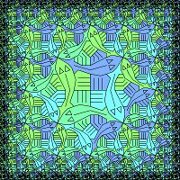
GeomLab is a simple functional language that we use at Oxford to help school students explore computer programming in a functional language with graphics. Recently, I have been working on a faster implementation that is based on compiling dynamically to code for the Java virtual machine. The project has become self-hosting, in that most of the GeomLab compiler is now written in its own language and compiles itself. The message of this talk is that using the JVM as a target makes it an easy and pleasant task to implement a programming language with reasonable performance, and better fun than ever as a personal programming project. Since GeomLab is open source, it can provide a springboard for your own experiments.
The beauty of bootstrapping and the joy of JITGeomLab is a simple functional language that we use at Oxford to help school students explore computer programming in a functional language with graphics. Recently, I have been working on a faster implementation that is based on compiling dynamically to code for the Java virtual machine. The project has become self-hosting, in that most of the GeomLab compiler is now written in its own language and compiles itself. The message of this talk is that using the JVM as a target makes it an easy and pleasant task to implement a programming language with reasonable performance, and better fun than ever as a personal programming project. Since GeomLab is open source, it can provide a springboard for your own experiments.
|
| Tue 26 Feb 2013, 1:00pm | Pizza with the Committee | |

|
Are you interested in getting involved with CUCaTS? Think you have what it takes to run Cambridge University's original Computer Science Society? If so, then come along to the Computer Lab at 1pm on Tuesday 26th February for free pizza, chat with the current committee and discover what we do behind the scenes. Since most of us are set to graduate at the end of this year, there are plenty of roles to fill at the upcoming AGM around the end of term!
Pizza with the CommitteeAre you interested in getting involved with CUCaTS? Think you have what it takes to run Cambridge University's original Computer Science Society? If so, then come along to the Computer Lab at 1pm on Tuesday 26th February for free pizza, chat with the current committee and discover what we do behind the scenes. Since most of us are set to graduate at the end of this year, there are plenty of roles to fill at the upcoming AGM around the end of term!
|
| Sun 24 Feb 2013, 8:45am | Varsity Paintballing Trip | |

|
YOU WILL NEED TO SIGN UP AGAIN EVEN IF YOU HAD SIGNED UP BEFORE THE EVENT WAS POSTPONED. (signup form)
Note: The time listed for this event denotes the time of departure of the coach from the Queens Road bus park.
With hopefully no further climatic caprioles to get in the way, we are organising a Varsity Paintballing Trip together with the Oxford University Computer Society. Courtesy of Palantir Technologies' generous sponsorship, the event will be FREE OF CHARGE, including transportation to and from the venue, for CUCaTS and Compsoc members to attend. (If you are not a member, we will charge you a token amount of £3.) NOTE however that, due to our arrangement ... (more)
Varsity Paintballing TripYOU WILL NEED TO SIGN UP AGAIN EVEN IF YOU HAD SIGNED UP BEFORE THE EVENT WAS POSTPONED. (signup form)
Note: The time listed for this event denotes the time of departure of the coach from the Queens Road bus park.
With hopefully no further climatic caprioles to get in the way, we are organising a Varsity Paintballing Trip together with the Oxford University Computer Society. Courtesy of Palantir Technologies' generous sponsorship, the event will be FREE OF CHARGE, including transportation to and from the venue, for CUCaTS and Compsoc members to attend. (If you are not a member, we will charge you a token amount of £3.) NOTE however that, due to our arrangement with Palantir, we can only invite current students of Computer Science, Mathematics and Natsci Physics.
Places are limited, so if you are interested, please RSVP as soon as possible using the signup form, and tell all your friends about it via facebook.
|
| Wed 13 Feb 2013, 8:00pm | Pub Social V | |
Wed 13 Feb 2013, 8:00pm | The Bathhouse

|
Well term is really starting to get into full swing and it's probably high time to take a quick break and nip to the pub with some absolutely excellent company (if I do say so myself). As before, anyone interested in discussing computers, computer science and technology should come along for a pint and a chat about those things (or anything else,really). Absolutely everyone is welcome to come, including non-members.
Pub Social VWell term is really starting to get into full swing and it's probably high time to take a quick break and nip to the pub with some absolutely excellent company (if I do say so myself). As before, anyone interested in discussing computers, computer science and technology should come along for a pint and a chat about those things (or anything else,really). Absolutely everyone is welcome to come, including non-members.
|
| Thu 07 Feb 2013, 6:00pm | How is Haskell tackling the multicore problem? | Dr Simon Marlow (Facebook) |
Thu 07 Feb 2013, 6:00pm | MR5, Centre for Mathematical Sciences
Dr Simon Marlow (Facebook) speaks on

|
Our computers are getting wider, not faster. Nowadays, to make our programs more efficient, we have to make them use more processors. Haskell is at the leading edge of research into parallel programming languages, and I'd like to use this talk to explore some of the ways in which we're making it easier to program parallel computers. The talk will cover two areas: parallel programming models (what the programmer writes), and runtime technology (how the system implements parallelism).
How is Haskell tackling the multicore problem?Our computers are getting wider, not faster. Nowadays, to make our programs more efficient, we have to make them use more processors. Haskell is at the leading edge of research into parallel programming languages, and I'd like to use this talk to explore some of the ways in which we're making it easier to program parallel computers. The talk will cover two areas: parallel programming models (what the programmer writes), and runtime technology (how the system implements parallelism).
|
| Thu 24 Jan 2013, 6:00pm | Molecular Programming | Professor Luca Cardelli (Microsoft Research) |
Professor Luca Cardelli (Microsoft Research) speaks on
|
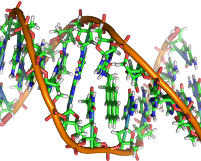
Nucleic acids (DNA/RNA) encode information digitally, and are currently the only truly 'user-programmable' entities at the molecular scale. They can be used to manufacture nano-scale structures, to produce physical forces, to act as sensors and actuators, and to do computation in between. Eventually we will be able to use them to design nanostructure at the bottom end of Moore's Law, and to interface them with biological machinery to detect and cure diseases at the cellular level under program control. The basic technology to create and manipulate these devices has existed for many years, but the imagination necessary to exploit them has been evolving slowly. Recently, some very simple computational schemes have been developed that are autonomous (run on their own once started) and involve only short (easily synthesizable) DNA strands with no other complex molecules.
We now need programming abstractions and tools that are suitable for molecular programming, and this requires a whole hierarchy of concepts to come together. Low-level molecular design is required to produce molecules that interact in the desired controllable ways. On that basis, we can then design various kinds of 'logic gates' and 'computational architectures', where much imagination is currently needed. We also need programming languages to organize complex designs both at the level of gate design, and at the level of circuit design. Since DNA computation is massively concurrent, some tricky and yet familiar programming issues arise: the need to formally verify circuit designs to avoid subtle deadlocks and race conditions, and the need to design high-level languages that exploit concurrency and stochasticity.
Molecular ProgrammingNucleic acids (DNA/RNA) encode information digitally, and are currently the only truly 'user-programmable' entities at the molecular scale. They can be used to manufacture nano-scale structures, to produce physical forces, to act as sensors and actuators, and to do computation in between. Eventually we will be able to use them to design nanostructure at the bottom end of Moore's Law, and to interface them with biological machinery to detect and cure diseases at the cellular level under program control. The basic technology to create and manipulate these devices has existed for many years, but the imagination necessary to exploit them has been evolving slowly. Recently, some very simple computational schemes have been developed that are autonomous (run on their own once started) and involve only short (easily synthesizable) DNA strands with no other complex molecules.
We now need programming abstractions and tools that are suitable for molecular programming, and this requires a whole hierarchy of concepts to come together. Low-level molecular design is required to produce molecules that interact in the desired controllable ways. On that basis, we can then design various kinds of 'logic gates' and 'computational architectures', where much imagination is currently needed. We also need programming languages to organize complex designs both at the level of gate design, and at the level of circuit design. Since DNA computation is massively concurrent, some tricky and yet familiar programming issues arise: the need to formally verify circuit designs to avoid subtle deadlocks and race conditions, and the need to design high-level languages that exploit concurrency and stochasticity.
|
| Wed 23 Jan 2013, 8:00pm | Pub Social IV | |

|
The final pub social of term will be on the evening of the last day of lectures. As before, anyone interested in discussing computers, computer science and technology should come along for a pint and a chat about those things (or anything else,really).
Absolutely everyone is welcome to come, including non-members.
The event on Facebook.
Pub Social IVThe final pub social of term will be on the evening of the last day of lectures. As before, anyone interested in discussing computers, computer science and technology should come along for a pint and a chat about those things (or anything else,really).
Absolutely everyone is welcome to come, including non-members.
The event on Facebook.
|
| Sun 20 Jan 2013, 7:30am | Varsity Paintballing Trip | |

|
UPDATE (2013-01-20): THE EVENT HAS BEEN POSTPONED BY THE VENUE DUE TO THE WRONG KIND OF SNOW.
Note: The time listed for this event is the time we will beginning paintballing. If you are getting the coach from Cambridge, you should be meeting at 7:20am
At the beginning of the coming term, we are organising a Varsity Paintballing Trip together with the Oxford University Computer Society. Courtesy of Palantir Technologies' generous sponsorship, the event will be FREE OF CHARGE, including transportation to and from the venue, for CUCaTS and Compsoc members to attend. (If you are not a member, we will charge you a token amount of £3.) NOTE however that, due to our arrangement with Palantir, we can only invite ... (more)
Varsity Paintballing TripUPDATE (2013-01-20): THE EVENT HAS BEEN POSTPONED BY THE VENUE DUE TO THE WRONG KIND OF SNOW.
Note: The time listed for this event is the time we will beginning paintballing. If you are getting the coach from Cambridge, you should be meeting at 7:20am
At the beginning of the coming term, we are organising a Varsity Paintballing Trip together with the Oxford University Computer Society. Courtesy of Palantir Technologies' generous sponsorship, the event will be FREE OF CHARGE, including transportation to and from the venue, for CUCaTS and Compsoc members to attend. (If you are not a member, we will charge you a token amount of £3.) NOTE however that, due to our arrangement with Palantir, we can only invite current students of Computer Science, Mathematics and Natsci Physics.
Places are limited, so if you are interested, please RSVP as soon as possible using the signup form, and tell all your friends about it via facebook.
|
| Wed 28 Nov 2012, 8:00pm | Pub Social III | |

|
The final pub social of term will be on the evening of the last day of lectures. As before, anyone interested in discussing computers, computer science and technology should come along for a pint and a chat about those things (or anything else,really).
Absolutely everyone is welcome to come, including non-members.
The event on Facebook.
Pub Social IIIThe final pub social of term will be on the evening of the last day of lectures. As before, anyone interested in discussing computers, computer science and technology should come along for a pint and a chat about those things (or anything else,really).
Absolutely everyone is welcome to come, including non-members.
The event on Facebook.
|
| Wed 21 Nov 2012, 6:00pm | Computing on Encrypted Data | Professor Nigel Smart (University of Bristol) |
Professor Nigel Smart (University of Bristol) speaks on

|
In the last couple of years amazing advances have been made on
techniques to perform computation on encrypted data. Some of the techniques
are even becoming practical. In this talk I will show a novel technique
which utilizes techniques used in Fully Homomorphic Encryption (FHE) schemes to
provide efficiency improvements in Multi-Party Computation (MPC) protocols.
No prior knowledge of FHE or MPC will be assumed.
Computing on Encrypted DataIn the last couple of years amazing advances have been made on
techniques to perform computation on encrypted data. Some of the techniques
are even becoming practical. In this talk I will show a novel technique
which utilizes techniques used in Fully Homomorphic Encryption (FHE) schemes to
provide efficiency improvements in Multi-Party Computation (MPC) protocols.
No prior knowledge of FHE or MPC will be assumed.
|
| Wed 14 Nov 2012, 8:00pm | Pub Social II | |

|
Well, the previous social (last week) was a resounding success by all accounts. The next one will take place on the 14th November (not tomorrow, but a week after), at 8pm, in the Castle Inn (on Castle Hill). As before, anyone interested in discussing computers, computer science and technology should come along for a pint and a chat about those things (or anything else, really).
Absolutely everyone is welcome to come, including non-members.
The event on Facebook.
Pub Social IIWell, the previous social (last week) was a resounding success by all accounts. The next one will take place on the 14th November (not tomorrow, but a week after), at 8pm, in the Castle Inn (on Castle Hill). As before, anyone interested in discussing computers, computer science and technology should come along for a pint and a chat about those things (or anything else, really).
Absolutely everyone is welcome to come, including non-members.
The event on Facebook.
|
| Wed 07 Nov 2012, 6:00pm | Selling category theory to the masses: a tale of food, spiders and Google | Professor Bob Coecke (University of Oxford) |
Wed 07 Nov 2012, 6:00pm | Room TBC, Centre for Mathematical Sciences
Professor Bob Coecke (University of Oxford) speaks on

|
We will demonstrate the following. Category theory, usually conceived as some very abstract form of metamathematics, is present everywhere around us. Explicitly, we show how it provides a kindergarten version of quantum theory, how it helps to automate quantum reasoning, and how it will help Google to understand sentences given the meaning of their words.
Selling category theory to the masses: a tale of food, spiders and GoogleWe will demonstrate the following. Category theory, usually conceived as some very abstract form of metamathematics, is present everywhere around us. Explicitly, we show how it provides a kindergarten version of quantum theory, how it helps to automate quantum reasoning, and how it will help Google to understand sentences given the meaning of their words.
|
| Wed 31 Oct 2012, 8:00pm | Pub Social | |

|
CUCaTS are holding our first ever (fortnightly) pub social and we'd like anyone interested in discussing computers, computer science and technology to come along for a chat.
Absolutely anyone is welcome to come, including non-members, but if you are a member (or sign up for membership there) CUCaTS will buy you your first drink this time round.
Pub SocialCUCaTS are holding our first ever (fortnightly) pub social and we'd like anyone interested in discussing computers, computer science and technology to come along for a chat.
Absolutely anyone is welcome to come, including non-members, but if you are a member (or sign up for membership there) CUCaTS will buy you your first drink this time round.
|
| Tue 30 Oct 2012, 5:00pm | Financial Technology: Algorithmic Trading and Social Media Analytics | Professor Philip Treleaven (University College London) |
Professor Philip Treleaven (University College London) speaks on
|
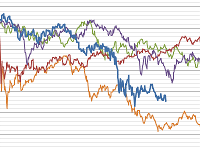
Two of the 'hottest' topics in financial technology are: a) high-frequency algorithmic trading where algorithmic trade automatically in milliseconds; and b) social media scraping and analytics such as using Twitter and News data to assess market sentiment. This presentation will describe the structure of Algorithmic Trading systems and how Social Media is scraped and sentiment analysis performed. It will then discuss applications in financial services and business analytics.
Financial Technology: Algorithmic Trading and Social Media AnalyticsTwo of the 'hottest' topics in financial technology are: a) high-frequency algorithmic trading where algorithmic trade automatically in milliseconds; and b) social media scraping and analytics such as using Twitter and News data to assess market sentiment. This presentation will describe the structure of Algorithmic Trading systems and how Social Media is scraped and sentiment analysis performed. It will then discuss applications in financial services and business analytics.
Philip TreleavenUniversity College London Philip Treleaven is Director of the UK Centre for Financial Computing and Business Analytics and Professor of Computing at UCL. The UK Centre is a collaboration of UCL, London School of Economics, London Business School and the major financial institutions and commercial organisations. The Centre undertakes analytics research in finance, retail, healthcare, services and sport. For the past 8 years the UK Centre has worked with many of the leading Investment Banks and Funds developing algorithmic trading systems, and for the past 3 years we have worked with the regulators on High-frequency trading risk and systemic risk. The UK Centre has over 60 PhD students working on finance and business analytics, and is unique in placing them in banks, funds and companies to develop advanced analytics and software. An additional 20-25 PhD students will join in October.
|
| Thu 18 Oct 2012, 3:00pm | Freshers' Squash | |

|
Come and join us for a chat and free food and drink including pizza, and find out more about CUCaTS. Freshers and non-freshers are both very welcome, and did I mention free food?
You'll also be able to sign up for the mailing list and/or become a member if you missed the chance to do so at the freshers' fair.
Freshers' SquashCome and join us for a chat and free food and drink including pizza, and find out more about CUCaTS. Freshers and non-freshers are both very welcome, and did I mention free food?
You'll also be able to sign up for the mailing list and/or become a member if you missed the chance to do so at the freshers' fair.
|
| Mon 15 Oct 2012, 6:00pm | Friction In The Machine: How Fluid Processes Allow Optimal Human-Computer Interaction | Mr Tim Ronan (Palantir Technologies) |
Mr Tim Ronan (Palantir Technologies) speaks on

|
It is well understood that humans and computers have different strengths
and weaknesses when it comes to solving problems. But what happens when
they need to work together? Is computational power, human ingenuity or
some mix of the two the key factor in arriving at the most efficient
solution? This talk will explore a surprising example from the world of
chess that helps to explain why Palantir chooses to build software in the
way it does.
As usual refreshments will be served 15 minutes before the start of the talk.
Friction In The Machine: How Fluid Processes Allow Optimal Human-Computer InteractionIt is well understood that humans and computers have different strengths
and weaknesses when it comes to solving problems. But what happens when
they need to work together? Is computational power, human ingenuity or
some mix of the two the key factor in arriving at the most efficient
solution? This talk will explore a surprising example from the world of
chess that helps to explain why Palantir chooses to build software in the
way it does.
As usual refreshments will be served 15 minutes before the start of the talk.
Tim RonanPalantir Technologies Tim Ronan was one of Palantir's first engineers in their Washington DC
office. Throughout Tim's time at Palantir, he has led our work with US
Federal Law Enforcement customers, started Palantir's business in New
Zealand, and been responsible for leading product vision on several
transformative capabilities. Tim is now based in London where he ensures
the success of Palantir's work across the UK, Europe, Latin America, and
Canada. Tim received his Bachelors degree from the University of Notre
Dame in Aerospace Engineering and his Masters degree from the University
of Virginia.
|
| Tue 02 Oct 2012, 11:00am | Freshers' Fair | |
Tue 02 Oct 2012, 11:00am | Kelsey Kerridge Sports Centre
|
Want to learn more about CUCaTS? Come and find our stall at the freshers' fair, which will be held on Tuesday 2nd October and Wednesday 3rd October at the Kelsey Kerridge Sports Centre.
It only takes a moment to sign up to our mailing list and you'll be informed about upcoming talks throughout the year. Computing and technology has implications for practically every subject, so it's worth finding out about our talks whatever your interests are.
If you're thinking about coming to one or more of our talks, you might want to consider paying for membership. You can do this at our stand and for only a few pounds you'll gain free entrance to all our talks this year, plus a huge number of other benefits.
Freshers' FairWant to learn more about CUCaTS? Come and find our stall at the freshers' fair, which will be held on Tuesday 2nd October and Wednesday 3rd October at the Kelsey Kerridge Sports Centre.
It only takes a moment to sign up to our mailing list and you'll be informed about upcoming talks throughout the year. Computing and technology has implications for practically every subject, so it's worth finding out about our talks whatever your interests are.
If you're thinking about coming to one or more of our talks, you might want to consider paying for membership. You can do this at our stand and for only a few pounds you'll gain free entrance to all our talks this year, plus a huge number of other benefits.
|
| Fri 15 Jun 2012, 4:30pm | Puzzlehunt | |
Fri 15 Jun 2012, 4:30pm | Great St Mary's
|
We've now written up an overview of the puzzlehunt, including puzzles and solution notes.
So it's that time of year again. Exams are over (or nearly over), and we find ourselves at a loss for sources of intellectual exercise. Therefore, CUCaTS will be holding a Puzzlehunt this Friday.
Wait, what on earth is a Puzzlehunt, anyway? Well, to shamelessly quote Wikipedia, "A puzzlehunt is a puzzle game where teams compete to solve a series of puzzles at a particular site, in multiple sites and/or via the internet. Groups of puzzles in a puzzle hunt are often connected by a metapuzzle, leading to answers which combine into a final set of solutions.". So there.
The hunt will commence shortly after the end of the ... (more)
PuzzlehuntWe've now written up an overview of the puzzlehunt, including puzzles and solution notes.
So it's that time of year again. Exams are over (or nearly over), and we find ourselves at a loss for sources of intellectual exercise. Therefore, CUCaTS will be holding a Puzzlehunt this Friday.
Wait, what on earth is a Puzzlehunt, anyway? Well, to shamelessly quote Wikipedia, "A puzzlehunt is a puzzle game where teams compete to solve a series of puzzles at a particular site, in multiple sites and/or via the internet. Groups of puzzles in a puzzle hunt are often connected by a metapuzzle, leading to answers which combine into a final set of solutions.". So there.
The hunt will commence shortly after the end of the garden party, provisionally starting at 5pm, and will last for 24 hours. The location will be provided closer to the time.
The hunt is free to enter, and food will be provided. We would appreciate it if potential teams would sign here to show their interest. You can still sign up if you don't have a team, and we will try to find you people to compete with.
We expect to meet at Great St. Mary's at 4:30pm. Those who are attending both our Garden Party and the Puzzlehunt are likely to walk from the former to the latter in a group.
|
| Fri 15 Jun 2012, 1:00pm | Science & Engineering Garden Party | |
Fri 15 Jun 2012, 1:00pm | Pembroke College Library Lawn

|
Organised jointly by several societies from science and engineering - CUPS, CUAS, SciSoc, CUES, CUCaTS and the Archimedeans - this is promising to be one of the highlights of the end of the year. Join us in Pembroke College's Library Lawn from 1-4pm for music, Pimms, and lots of refreshments!
Tickets are sold out, and due to capacity limits we will be unable to sell any at the door.
Science & Engineering Garden PartyOrganised jointly by several societies from science and engineering - CUPS, CUAS, SciSoc, CUES, CUCaTS and the Archimedeans - this is promising to be one of the highlights of the end of the year. Join us in Pembroke College's Library Lawn from 1-4pm for music, Pimms, and lots of refreshments!
Tickets are sold out, and due to capacity limits we will be unable to sell any at the door.
|
| Tue 08 May 2012, 5:30pm | Meta-Morphogenesis: Evolution of mechanisms for producing minds | Professor Aaron Sloman (University of Birmingham) |
Tue 08 May 2012, 5:30pm | Auditorium Lounge, Robinson College
Professor Aaron Sloman (University of Birmingham) speaks on

|
* Please note this talk is on a TUESDAY at 5:30PM, unlike most other talks we have held. *
Alan Turing's work on morphogenesis (see below) explored how micro-interactions
in physicochemical structures might account for global transformations from a
fertilized egg to an animal or plant, within a single organism.
I'll outline a rudimentary theory of "meta-morphogenesis" that aims to show how,
over generations, interactions between changing environments, changing animal
morphology, and previously evolved information-processing capabilities might
combine to produce increasingly complex forms of "informed control", initially
just control of physical behaviour, then later also informed control of
information-processing. This potentially explains philosophically puzzling
features of animal (including human) minds, including the existence of "qualia".
It is also related to the transformation of empirical knowledge into a "generative"
or "deductive" form, a process labelled "Representational Redescription" by Annette
Karmiloff-Smith[*]. I suspect that such processes provide the foundation for human
mathematical competences.
Meta-Morphogenesis: Evolution of mechanisms for producing minds * Please note this talk is on a TUESDAY at 5:30PM, unlike most other talks we have held. *
Alan Turing's work on morphogenesis (see below) explored how micro-interactions
in physicochemical structures might account for global transformations from a
fertilized egg to an animal or plant, within a single organism.
I'll outline a rudimentary theory of "meta-morphogenesis" that aims to show how,
over generations, interactions between changing environments, changing animal
morphology, and previously evolved information-processing capabilities might
combine to produce increasingly complex forms of "informed control", initially
just control of physical behaviour, then later also informed control of
information-processing. This potentially explains philosophically puzzling
features of animal (including human) minds, including the existence of "qualia".
It is also related to the transformation of empirical knowledge into a "generative"
or "deductive" form, a process labelled "Representational Redescription" by Annette
Karmiloff-Smith[*]. I suspect that such processes provide the foundation for human
mathematical competences.
|
| Thu 08 Mar 2012, 6:00pm | The Theory behind TheoryMine | Professor Alan Bundy (University of Edinburgh) |
Thu 08 Mar 2012, 6:00pm | Mong Hall, Sidney Sussex
Professor Alan Bundy (University of Edinburgh) speaks on

|
We describe the technology behind the TheoryMine novelty gift company, which sells the rights to name novel mathematical theorems. A tower of four computer systems is used to generate recursive theories, to speculate conjectures in those theories and then to prove these conjectures. All stages of the process are entirely automatic. The process guarantees large numbers of sound, novel theorems of some intrinsic merit.
The Theory behind TheoryMineWe describe the technology behind the TheoryMine novelty gift company, which sells the rights to name novel mathematical theorems. A tower of four computer systems is used to generate recursive theories, to speculate conjectures in those theories and then to prove these conjectures. All stages of the process are entirely automatic. The process guarantees large numbers of sound, novel theorems of some intrinsic merit.
Alan BundyUniversity of Edinburgh A concept we refer to as the biological constraint is shown to be able where id=11;
to explain the effectiveness of mathematical descriptions of the
universe, as well as accounting for the origin of life and our ability
to think logically. The biological constraint, which can be studied
systematically through the use of appropriate models, refers to
selection in the biological realm in favour of mechanisms that have wide
applicability, a subset of which have mathematical character that can
evolve to ever subtler forms. The precise conformance of physical
phenomena to precise mathematical laws is related to the enforcement of
symmetry.
|
| Thu 01 Mar 2012, 6:00pm | Intelligence and Security in a Digital Age | Professor Sir David Omand (King's College London; Former Director of GCHQ) |
Thu 01 Mar 2012, 6:00pm | Winstanley Lecture Hall, Trinity College
Professor Sir David Omand (King's College London; Former Director of GCHQ) speaks on

|
In the talk I will look at the way that successive technological advances have shaped the past world of secret intelligence and suggest that the process continues with the application of digital technologies to intelligence access and analysis. I shall examine some of the ethical issues that recent developments have created and suggest a model for examining the limits that society should impose on their use for public security.
Intelligence and Security in a Digital AgeIn the talk I will look at the way that successive technological advances have shaped the past world of secret intelligence and suggest that the process continues with the application of digital technologies to intelligence access and analysis. I shall examine some of the ethical issues that recent developments have created and suggest a model for examining the limits that society should impose on their use for public security.
David OmandKing's College London; Former Director of GCHQ A concept we refer to as the biological constraint is shown to be able where id=11;
to explain the effectiveness of mathematical descriptions of the
universe, as well as accounting for the origin of life and our ability
to think logically. The biological constraint, which can be studied
systematically through the use of appropriate models, refers to
selection in the biological realm in favour of mechanisms that have wide
applicability, a subset of which have mathematical character that can
evolve to ever subtler forms. The precise conformance of physical
phenomena to precise mathematical laws is related to the enforcement of
symmetry.
|
| Wed 29 Feb 2012, 1:30pm | 3rd Annual General Meeting | |
Wed 29 Feb 2012, 1:30pm | LT2, Computer Laboratory
|
We will be reviewing the society's work over the past year and electing a new Executive Committee - all members are welcome to vote and/or stand for positions! Free pizza shall be served.
3rd Annual General MeetingWe will be reviewing the society's work over the past year and electing a new Executive Committee - all members are welcome to vote and/or stand for positions! Free pizza shall be served.
|
| Thu 16 Feb 2012, 6:00pm | Using Machine Learning to Solve Real-World Problems | Mr David North (CoreFiling Ltd) |
Thu 16 Feb 2012, 6:00pm | Trinity Hall Lecture Theatre, Trinity Ln
Mr David North (CoreFiling Ltd) speaks on
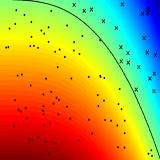
|
How do you approach a classification problem involving thousands of categories rather than the 'usual’ five or six? What happens when your data-set is several gigabytes and growing? What open-source tools are available, are they any good, and can they be put to commercial use? How do you measure the system’s effectiveness when you’re not allowed to see the real data because of client confidentiality?
David North, from Oxford-based software company CoreFiling, will aim to answer all these questions and more in a talk on machine learning from an industry perspective.
Using Machine Learning to Solve Real-World ProblemsHow do you approach a classification problem involving thousands of categories rather than the 'usual’ five or six? What happens when your data-set is several gigabytes and growing? What open-source tools are available, are they any good, and can they be put to commercial use? How do you measure the system’s effectiveness when you’re not allowed to see the real data because of client confidentiality?
David North, from Oxford-based software company CoreFiling, will aim to answer all these questions and more in a talk on machine learning from an industry perspective.
|
| Thu 09 Feb 2012, 6:00pm | (Failing to) avoid success at all costs: the Haskell story | Professor Simon Peyton Jones (Microsoft Research) |
Professor Simon Peyton Jones (Microsoft Research) speaks on

|
Haskell is twenty one years old, an age at which most programming languages are either dead and buried, or else have become mainstream and hence frozen in a web of backward-compatibility constraints. Haskell is different: it is in rude health, is widely used (but not too widely!), and is still in a state of furious innovation.
In this talk I'll reflect on this two-decade journey, I'll discuss Haskell's birth and evolution, including some of the research and engineering challenges we faced in design and implementation. I'll focus particularly on the ideas that have turned out, in retrospect, to be most important and influential, as well as sketching some current developments and making some wild guesses about the future.
(Failing to) avoid success at all costs: the Haskell storyHaskell is twenty one years old, an age at which most programming languages are either dead and buried, or else have become mainstream and hence frozen in a web of backward-compatibility constraints. Haskell is different: it is in rude health, is widely used (but not too widely!), and is still in a state of furious innovation.
In this talk I'll reflect on this two-decade journey, I'll discuss Haskell's birth and evolution, including some of the research and engineering challenges we faced in design and implementation. I'll focus particularly on the ideas that have turned out, in retrospect, to be most important and influential, as well as sketching some current developments and making some wild guesses about the future.
Simon Peyton JonesMicrosoft Research A concept we refer to as the biological constraint is shown to be able where id=11;
to explain the effectiveness of mathematical descriptions of the
universe, as well as accounting for the origin of life and our ability
to think logically. The biological constraint, which can be studied
systematically through the use of appropriate models, refers to
selection in the biological realm in favour of mechanisms that have wide
applicability, a subset of which have mathematical character that can
evolve to ever subtler forms. The precise conformance of physical
phenomena to precise mathematical laws is related to the enforcement of
symmetry.
|
| Thu 26 Jan 2012, 6:00pm | On Origins | Nobel Laureate, Professor Brian Josephson (University of Cambridge) |
Nobel Laureate, Professor Brian Josephson (University of Cambridge) speaks on

|
A concept we refer to as the biological constraint is shown to be able
to explain the effectiveness of mathematical descriptions of the
universe, as well as accounting for the origin of life and our ability
to think logically. The biological constraint, which can be studied
systematically through the use of appropriate models, refers to
selection in the biological realm in favour of mechanisms that have wide
applicability, a subset of which have mathematical character that can
evolve to ever subtler forms. The precise conformance of physical
phenomena to precise mathematical laws is related to the enforcement of
symmetry.
On OriginsA concept we refer to as the biological constraint is shown to be able
to explain the effectiveness of mathematical descriptions of the
universe, as well as accounting for the origin of life and our ability
to think logically. The biological constraint, which can be studied
systematically through the use of appropriate models, refers to
selection in the biological realm in favour of mechanisms that have wide
applicability, a subset of which have mathematical character that can
evolve to ever subtler forms. The precise conformance of physical
phenomena to precise mathematical laws is related to the enforcement of
symmetry.
Brian JosephsonUniversity of Cambridge A concept we refer to as the biological constraint is shown to be able
to explain the effectiveness of mathematical descriptions of the
universe, as well as accounting for the origin of life and our ability
to think logically. The biological constraint, which can be studied
systematically through the use of appropriate models, refers to
selection in the biological realm in favour of mechanisms that have wide
applicability, a subset of which have mathematical character that can
evolve to ever subtler forms. The precise conformance of physical
phenomena to precise mathematical laws is related to the enforcement of
symmetry.
|
| Thu 01 Dec 2011, 6:00pm | Unsupervised Machine Learning and Linguistics | Professor Alex Clark (Royal Holloway, University of London) |
Thu 01 Dec 2011, 6:00pm | Winstanley Lecture Hall, Trinity College
Professor Alex Clark (Royal Holloway, University of London) speaks on
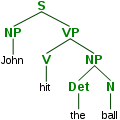
|
The fundamental problem of linguistics is to find how knowledge of language is represented and how that knowledge is acquired by children learning their first language; understanding or solving this problem would open the door to a new generation of intelligent language processing systems. This is fundamentally a computational problem, which can be studied using the tools of formal language theory and computational learning. Solving it requires reconceptualising some basic concepts -- including the relationship between a grammar and the language it defines.
In this talk I will give an overview of this field (assuming no prior knowledge of linguistics or machine learning) and discuss some recent technical results in distributional learning that can potentially provide a solution to this problem. These techniques involve modelling the relationship between substrings and the contexts that they can appear in -- these give rise to algorithms for learning classes of context free and context sensitive languages that seem to be a good match for the properties of natural language.
Unsupervised Machine Learning and LinguisticsThe fundamental problem of linguistics is to find how knowledge of language is represented and how that knowledge is acquired by children learning their first language; understanding or solving this problem would open the door to a new generation of intelligent language processing systems. This is fundamentally a computational problem, which can be studied using the tools of formal language theory and computational learning. Solving it requires reconceptualising some basic concepts -- including the relationship between a grammar and the language it defines.
In this talk I will give an overview of this field (assuming no prior knowledge of linguistics or machine learning) and discuss some recent technical results in distributional learning that can potentially provide a solution to this problem. These techniques involve modelling the relationship between substrings and the contexts that they can appear in -- these give rise to algorithms for learning classes of context free and context sensitive languages that seem to be a good match for the properties of natural language.
Alex ClarkRoyal Holloway, University of London A concept we refer to as the biological constraint is shown to be able where id=11;
to explain the effectiveness of mathematical descriptions of the
universe, as well as accounting for the origin of life and our ability
to think logically. The biological constraint, which can be studied
systematically through the use of appropriate models, refers to
selection in the biological realm in favour of mechanisms that have wide
applicability, a subset of which have mathematical character that can
evolve to ever subtler forms. The precise conformance of physical
phenomena to precise mathematical laws is related to the enforcement of
symmetry.
|
| Thu 24 Nov 2011, 6:00pm | Don't Get Your Face Stolen! A Talk on ePassport Cryptography | Mr Jan Kjærsgaard (Cryptomathic) |
Thu 24 Nov 2011, 6:00pm | Mong Hall, Sidney Sussex
Mr Jan Kjærsgaard (Cryptomathic) speaks on

|
With the introduction of electronic passports containing sensitive biometric information like fingerprints and iris scans, we face a new world of challenges. How do we allow a legitimate inspection system to read the passport while at the same time ensure that nobody else can? This talk discusses the advanced cryptography, primitives, and protocols involved in ePassports and inspection systems.
Don't Get Your Face Stolen! A Talk on ePassport CryptographyWith the introduction of electronic passports containing sensitive biometric information like fingerprints and iris scans, we face a new world of challenges. How do we allow a legitimate inspection system to read the passport while at the same time ensure that nobody else can? This talk discusses the advanced cryptography, primitives, and protocols involved in ePassports and inspection systems.
Jan KjærsgaardCryptomathic A concept we refer to as the biological constraint is shown to be able where id=11;
to explain the effectiveness of mathematical descriptions of the
universe, as well as accounting for the origin of life and our ability
to think logically. The biological constraint, which can be studied
systematically through the use of appropriate models, refers to
selection in the biological realm in favour of mechanisms that have wide
applicability, a subset of which have mathematical character that can
evolve to ever subtler forms. The precise conformance of physical
phenomena to precise mathematical laws is related to the enforcement of
symmetry.
|
| Thu 17 Nov 2011, 6:00pm | Imaginary Interfaces: Interacting Spatially Without Visual Feedback | Mr Sean Gustafson (University of Potsdam) |
Thu 17 Nov 2011, 6:00pm | South Lecture Room, Department of Archaeology, Downing Street
Mr Sean Gustafson (University of Potsdam) speaks on

|
To increase mobility, designers are creating ever smaller mobile devices. After a certain point they are so small that a screen cannot be included and the device no longer supports any sort of spatial interaction (such as pointing) because, seemingly, there is nothing to point at. In this talk, I will present Imaginary Interfaces, a vision of hypermobile devices that rejects this notion. These completely non-visual interfaces retain the model of spatial interaction by sensing where the user is pointing in free space or on their body. I will present a depth camera based prototype, called Imaginary Phone, which allows users to operate a real iPhone by mimicking iPhone interaction on their empty palm and a set user studies that explore methods of learning a non-visual pointing environment.
Imaginary Interfaces: Interacting Spatially Without Visual FeedbackTo increase mobility, designers are creating ever smaller mobile devices. After a certain point they are so small that a screen cannot be included and the device no longer supports any sort of spatial interaction (such as pointing) because, seemingly, there is nothing to point at. In this talk, I will present Imaginary Interfaces, a vision of hypermobile devices that rejects this notion. These completely non-visual interfaces retain the model of spatial interaction by sensing where the user is pointing in free space or on their body. I will present a depth camera based prototype, called Imaginary Phone, which allows users to operate a real iPhone by mimicking iPhone interaction on their empty palm and a set user studies that explore methods of learning a non-visual pointing environment.
Sean GustafsonUniversity of Potsdam A concept we refer to as the biological constraint is shown to be able where id=11;
to explain the effectiveness of mathematical descriptions of the
universe, as well as accounting for the origin of life and our ability
to think logically. The biological constraint, which can be studied
systematically through the use of appropriate models, refers to
selection in the biological realm in favour of mechanisms that have wide
applicability, a subset of which have mathematical character that can
evolve to ever subtler forms. The precise conformance of physical
phenomena to precise mathematical laws is related to the enforcement of
symmetry.
|
| Thu 03 Nov 2011, 6:00pm | Great Ideas of Computing Science: from Aristotle to Euclid | Professor Sir Tony Hoare (Microsoft Research) |
Thu 03 Nov 2011, 6:00pm | MR3, Centre for Mathematical Sciences, Clarkson Rd
Professor Sir Tony Hoare (Microsoft Research) speaks on
|
Great ideas tell us how to think: how to think effectively about many areas of essential interest to us, because they tell us about ourselves and about the world we live in. They embody principles that endure and evolve over a long period of time. They form the basis of a teaching syllabus for the education of students at school and at Universities. The application of great ideas brings cultural, intellectual, moral, and/or economic benefit to those who adopt and exploit them. And a great idea is often associated with the name of a great thinker, who first formulated and propagated the principles in published form.
It is much easier to recognise great ideas that have been formulated a long time ago, for example in the civilization of Ancient Greece. We know that these ideas have already stood the test of time; they have already been taught to our schoolchildren and university students through many generations. And their continuing relevance to today's world of computers and Computer Science are convincing evidence of their versatility and their enduring power to deliver benefit to mankind.
This lecture will concentrate on Aristotle's logic, and Euclid's geometry, and draw interesting analogies with some of the basic principles of Computer Science.
Great Ideas of Computing Science: from Aristotle to EuclidGreat ideas tell us how to think: how to think effectively about many areas of essential interest to us, because they tell us about ourselves and about the world we live in. They embody principles that endure and evolve over a long period of time. They form the basis of a teaching syllabus for the education of students at school and at Universities. The application of great ideas brings cultural, intellectual, moral, and/or economic benefit to those who adopt and exploit them. And a great idea is often associated with the name of a great thinker, who first formulated and propagated the principles in published form.
It is much easier to recognise great ideas that have been formulated a long time ago, for example in the civilization of Ancient Greece. We know that these ideas have already stood the test of time; they have already been taught to our schoolchildren and university students through many generations. And their continuing relevance to today's world of computers and Computer Science are convincing evidence of their versatility and their enduring power to deliver benefit to mankind.
This lecture will concentrate on Aristotle's logic, and Euclid's geometry, and draw interesting analogies with some of the basic principles of Computer Science.
Tony HoareMicrosoft Research A concept we refer to as the biological constraint is shown to be able where id=11;
to explain the effectiveness of mathematical descriptions of the
universe, as well as accounting for the origin of life and our ability
to think logically. The biological constraint, which can be studied
systematically through the use of appropriate models, refers to
selection in the biological realm in favour of mechanisms that have wide
applicability, a subset of which have mathematical character that can
evolve to ever subtler forms. The precise conformance of physical
phenomena to precise mathematical laws is related to the enforcement of
symmetry.
|
| Thu 20 Oct 2011, 6:00pm | Photonic Quantum Information Science and Technologies | Professor Jeremy O'Brien (University of Bristol) |
Thu 20 Oct 2011, 6:00pm | South Lecture Room, Department of Archaeology, Downing Street
Professor Jeremy O'Brien (University of Bristol) speaks on

|
The theory of quantum mechanics was developed at the beginning of the twentieth century to better explain the spectra of light emitted by atoms. At the time, many people believed that physics was almost completely understood, with only a few remaining anomalies to be ‘ironed out’. The full theory of quantum mechanics emerged as a completely unexpected description of nature at a fundamental level. It portrays a world that is fundamentally probabilistic, where a single object can be in two places at once—superposition—and where two objects in remote locations can be instantaneously connected—entanglement. These unusual properties have been observed, and quantum mechanics remains the most successful theory ever developed, in terms of the precision of its predictions. Today, we are learning how to harness these surprising quantum effects to realize profoundly new quantum technologies. This lecture will examine how single particles of light—photons—are being used to develop secure communication systems based on the laws of physics, precision measurements using entangled light, and information processors that promise exponentially greater computational power for particular tasks.
Photonic Quantum Information Science and TechnologiesThe theory of quantum mechanics was developed at the beginning of the twentieth century to better explain the spectra of light emitted by atoms. At the time, many people believed that physics was almost completely understood, with only a few remaining anomalies to be ‘ironed out’. The full theory of quantum mechanics emerged as a completely unexpected description of nature at a fundamental level. It portrays a world that is fundamentally probabilistic, where a single object can be in two places at once—superposition—and where two objects in remote locations can be instantaneously connected—entanglement. These unusual properties have been observed, and quantum mechanics remains the most successful theory ever developed, in terms of the precision of its predictions. Today, we are learning how to harness these surprising quantum effects to realize profoundly new quantum technologies. This lecture will examine how single particles of light—photons—are being used to develop secure communication systems based on the laws of physics, precision measurements using entangled light, and information processors that promise exponentially greater computational power for particular tasks.
Jeremy O'BrienUniversity of Bristol A concept we refer to as the biological constraint is shown to be able where id=11;
to explain the effectiveness of mathematical descriptions of the
universe, as well as accounting for the origin of life and our ability
to think logically. The biological constraint, which can be studied
systematically through the use of appropriate models, refers to
selection in the biological realm in favour of mechanisms that have wide
applicability, a subset of which have mathematical character that can
evolve to ever subtler forms. The precise conformance of physical
phenomena to precise mathematical laws is related to the enforcement of
symmetry.
|
| Wed 12 Oct 2011, 2:00pm | Michaelmas Freshers' Squash | |
Wed 12 Oct 2011, 2:00pm | South Lecture Room, Department of Archaeology, Downing Street

|
Come and join us for chats and free food, and find out more about CUCaTS. Freshers and non-freshers both very welcome: we believe everyone interested in computing and technology deserves free food, regardless of naivetë. ;-)
We'll be offering life membership at the discounted price of £8.00, and a Prize Draw involving a remote-controlled helicopter
among other goodies. We'd be delighted to see you there!
If you have any questions beforehand, don't hesitate to ask us.
Michaelmas Freshers' SquashCome and join us for chats and free food, and find out more about CUCaTS. Freshers and non-freshers both very welcome: we believe everyone interested in computing and technology deserves free food, regardless of naivetë. ;-) We'll be offering life membership at the discounted price of £8.00, and a Prize Draw involving a remote-controlled helicopter
among other goodies. We'd be delighted to see you there! If you have any questions beforehand, don't hesitate to ask us.
|
|